I chose Innovation & Leadership because, after $20BOSS last year, I was keen for more business experience and another shot at runway. During my past entrepreneurship experiences, we always made semi-successful products but in my latest entrepreneurship experience, I experienced success by selling out at the very end of our $20BOSS market. My understanding of entrepreneurship at the time was just being a business owner, but now with a better understanding of the design thinking process and a better understanding of how to think differently I believe that my new business can be even more successful than my last.
Indentifying Passions & Strengths
After a quick introduction to the course, we were told to identify our own passions and strengths. We were told to do a quick quiz to see what our strengths were and these were my top 5 strengths. Humour was my top strength which surprised me, I knew it would be in my top 5 strengths but I didn’t think it would be number 1, this discovery could help me when I have to advertise for my business. Hope could also help me get through the prototyping phase.

These are my top 5 strengths
After figuring out what some of my strengths were, I then had to figure out what my passions were, this task was a lot more complicated than the last taking around a lesson to complete. After much thought and careful consideration, I decided these were my top 5 passions. I don’t really see how these could help me make a business but I really like business and I think it is quite fun to experiment with products and see how they do.

Vision Board Task
After a few more classes, our next task was to create a vision board consisting of 20 toys which we would then share and get feedback on. We did this to get an idea of the types of toys we were going to make and get some inspiration and feedback on our ideas before we got to the ideating stage of the design thinking process. This was my vision board.
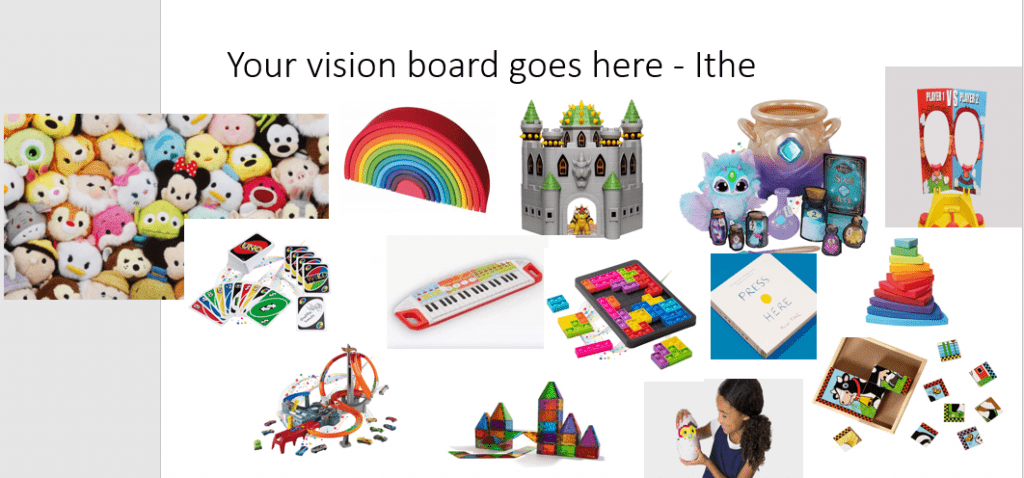
Now if you count carefully you’ll realise that there are only 14 toys, not 20, that’s because I thought this task would be a lot easier than it was and wasted a lot of time. My favourite toy from these must be those colourful, cube things I don’t really know what they’re called but they look really cool, and most people who commented on my vision board thought that the pop-up Tetris puzzle would be the best pick. From a business standpoint, I must agree with them but the blocks are more intriguing for me personally.
Our interview with Ms. Mano
Now for our actual Creative Toy task; 3 groups had to make 7 interview questions for Ms. Mano(the head of the ELC) and the results of this would directly impact our toys. We tried to contact her and meet with her in week 3 but things didn’t work out and now we’re meeting with her on Wednesday of week 4. These are my proposed interview questions:

We were also doing a bunch of brainstorming and big thinking activities to get us thinking differently which were fun(some more than others).
After doing the interview with Ms. Mano these were the answers to our prior interview questions:

Design thinking process
At this point in my business journey, I was in my empathise stage of the design thinking process. The design thinking process is meant to help with making products in business and it has 5 different steps: empathise, define, ideate, prototyping and test. If your test/prototype messes up, you go back to the empathise stage and try again. The empathy stage is the most important step in the design thinking process because in this step you actually ask your target audience what they want and then you make a product that aligns with your strengths, passions and their answer.
My “prototype”/idea
After we finished our empathise stage, we moved on to ideating. After our vision boards, we had to start taking that inspiration and try to make a product and sketch it out(our next task).
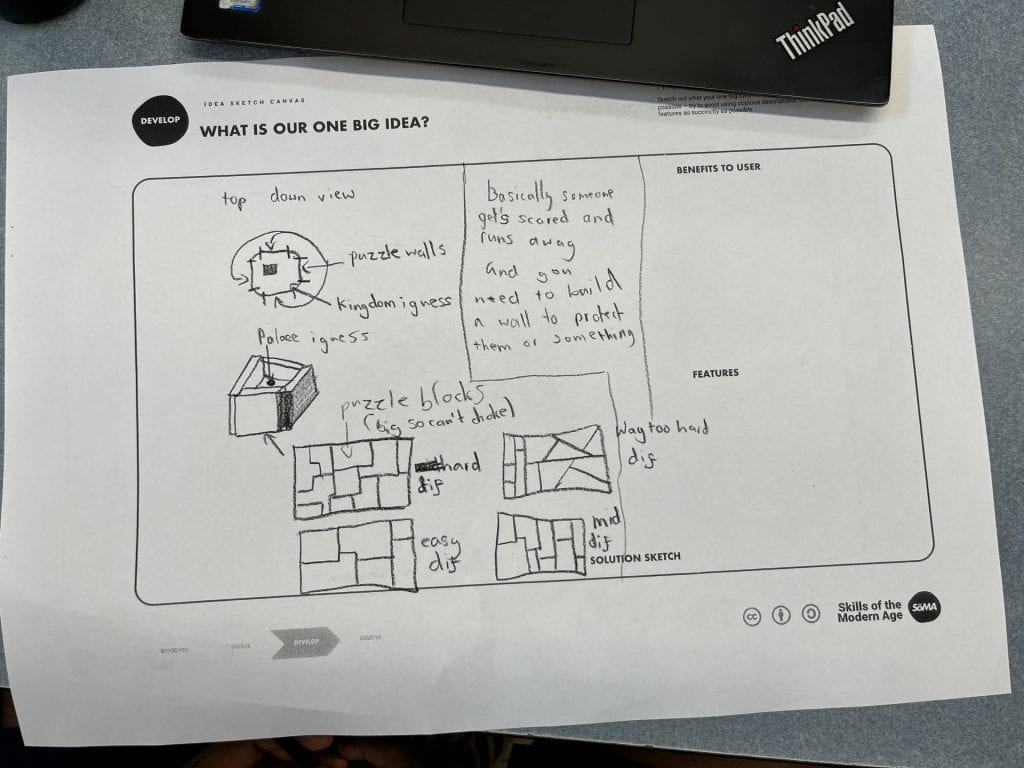
I got my idea from a show and thought that this product could do well because it seems like it would be fun to play with and it could help small children with motor skills. Basically, you have to build 4 walls around a kingdom in order to protect it I guess. But here’s the catch you have to build these walls by yourself and each wall gets respectively harder to build. We were learning how to use the workshop equipment last time we were in the workshop.
This is all we’ve done so far in innovation and leadership, I’m really keen to see what comes next, to make my first prototype and to finally release my product.