Category: Projects

Project Utopia 2022 – Future Of Fremantle –

-What Is Project Utopia?-

Project Utopia was our project on the redesigning of Binowee Yaringa, which is Noongar for green place by the sea. It included many past lesson factors such as The Giver, liveability, and other things that would help us remodel the port in a way that would be sustainable as well as impact the people living there. As part of the project, we brainstormed some liveability factors and what Global Goals they connected to, prepared speeches and even made a to correctly to scale model with all the things that we would include in the new design. This may have included lots of greenspace, retail areas, and other forms of transport other than cars. To help us understand the amount of space there was, we went to Fremantle Port and filled out a small booklet about the history and Aboriginal heritage of Fremantle.

-The Giver-

The Giver was a book we studied in Term 2. The main idea of it was a display of a perfect world (a utopia) compared to a imperfect world (a dystopia). The community, was an example of a ‘Utopia’. This meant there was no pain, no emotions, and no real families. The main character, Jonas, was given the role of the receiver of memory, which meant he would be given all the memories of the past, which included pain and sadness, but also happiness and colours. As he received all these memories, he started to think about the current world he was living in, and the potential in it. This helped us in the redesign of Binowee Yaringa because it gave us insight to what a utopia and dystopia would be like and the concept of it.

-Geography: Liveability Factors-

Before we started working on the model and speeches, we learnt about the 5 factors of liveability, which includes environment, society, culture, economy, and infrastructure. This connects into the Future of Fremantle by informing us of some things we may need to include in our design so that the port will be liveable for the people living there and sustainable for the environment. It was very helpful when we were writing our speeches, as some things we needed to include in our topic was how it would be liveable for the people living in Fremantle.

-Capabilities-

The Capabilities Wheel

Some capabilities I have used in Project Utopia includes effective communication between both me and my peers, as this enabled us to work better as a team so we could achieve more in less time. This was very important when building the model, because it required a lot of leadership, collaborative working, flexibility and organisation coming from everyone so the model could be done in time. Another thing was problem solving when things didn’t turn out the way they should have. This was also important for model building because if something didn’t go right,

we would need to prioritise quickly before that problem got worse. Another capability used in Project Utopia was organisation, especially in preparing our speeches. Our speeches were based on what was going to be included in the new design. I needed to be organised and practise before we were going to perform in front of the class. If I wasn’t organised enough before this happened, I wouldn’t know the speech well enough to perform. Overall, Project Utopia was a good experience and has definitely improved lots of my skills.

-Speeches & Cospace (Term 3)-

In Term 3, we were working on writing our speeches, making the model, and creating our cospaces. Cospaces are digital 3D models that you can use to create different scenes. We all had set topics to write and create, then we would present to the parents about all our ideas. To learn about public speaking, we practised some of the skills such as body language, eye contact, speed, and expressions. This all helped us to present in a formal but informative way. We had to collaborate as a class to put all of our ideas together to help make the final model . Clear communication was key in this because if we weren’t focusing and working as a team, we wouldn’t have been able to get the full model done in time. My topic that I had to write about was the town square. I had to present about how the town square is liveable and how it would benefit many people. I also had a cospace to accompany it, featuring a water fountain in the centre and many retail buildings surrounding it. On the model, which was to scale, the town square equalled a total of 100 metres by 100 metres, as said in my speech, it was better for people’s eyes visually and they feel a lot safer in a smaller space.

-Some Showcase Pictures-

Working On The Model
Finished Model
Liveability & Global Goals Brainstorming
Project Utopia Booklet Cover

Connected Learning-NEXUS

NEXUS-Digital Tech Rotation

Connected Learning this round was in NEXUS-Digital Tech. We were exploring new computer skills using things like Adobe Spark, Canva, Paint 3D and a lot more. For my ePortfolio post, I decided to work on Canva, as I really enjoyed using it. I decided to design a landscape poster with an animation. I found the NEXUS sessions very helpful with tech skills and definitely learnt more about different platforms you can use to create a school project or just play around with for fun. I also learnt what makes visual poster and presentations look better with just using 6 simple steps. In the future, my projects will definitely look better just from these fun sessions. ✨✨✨

Greywater Recycling-Science (Project Utopia)

Greywater Recycling

What is greywater?

Greywater is water that has previously been used for things like sinks, washing machines, showers and baths. If handled carefully, it can be reused in the garden or flushing toilets. Although you should never reuse greywater if it came from the toilet, washing nappies or kitchen water. Greywater should never be used for handling vegetables, fruit or anything you want to eat.

How it works:

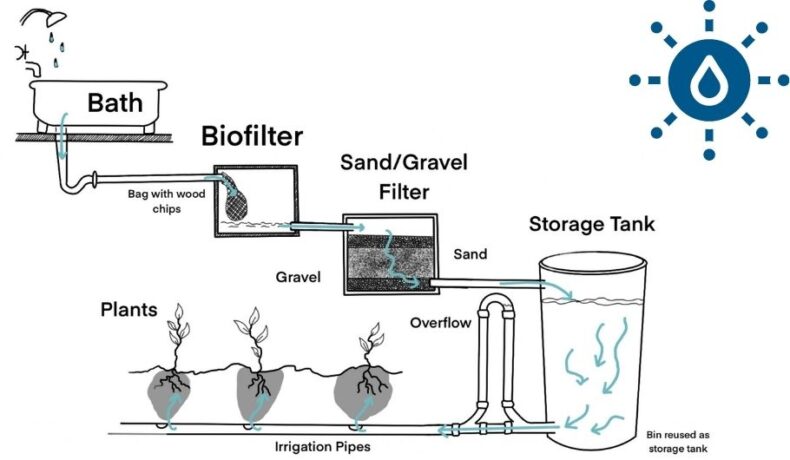
Greywater System (Everything you need to know) - Climatebiz

The used water from a bath travels down the drain into a biofilter. The biofilter filters any chemicals or harmful substances from it. The water then travels down into a sand/gravel filter which removes any unnatural solids from it. The greywater continues to travel into a storage tank which distributes the water into your garden and helps water the plants.

Today, less than 1% of the world’s water is drinkable. (No chemicals or toxins.) Greywater wouldn’t be very safe for a person to drink, as it has already been used and is most likely very dirty. Blackwater is very unsafe and should be disposed of immediately. It contains lots of chemicals and toxic waste. Examples of blackwater would be used water from toilets or frequently used water from kitchens.

How can we incorporate that into Project Utopia?

We can reuse greywater by installing greywater storage tanks in our houses. Using greywater tanks saves water and helps your garden too. Creating new buildings such as houses or sporting complexes with greywater recycling mechanics in place can also contribute to Project Utopia. ✨✨✨

Introducing Myself in Chinese

Click here to view my Voki character link:

https://tinyurl.com/y887lulf

This term, we learnt how to use measure words in a sentence. We know that the number always comes first, the measure word second and the noun last. The most common measure word used in everyday life is gè (个), which is used when referring to a number of people, and ‘kǒu’ (口), which is used when referring to the total number of household family members. Our task was to create a script about our family, pets and ourselves. We recorded our voice using Voki create and made a character that symbolised us talking about our family.

Hello! (Ni hao)

My name is Natasha. (Wo de mingzi shi Natasha)

I am 12 years old. (Wo shi er sui)

I have 4 people in my family. (Wo jia you si kou ren)

I have my mum, dad, younger brother and myself in my family. (Wo jia you mama, baba, didi, he wo)

I have one younger brother. His name is Toby. He is 5 years old. (Wo you yi ge didi. Ta de mingzi shi Toby. Ta wu sui)

My mum’s name is Jocelyn. She is 41 years old. (Wo de mama shi Jocelyn. Ta de shi si yi sui)

My dad’s name is Joseph. He is 41 years old. (Wo de baba shi Joseph. Ta de shi si yi sui)

My pets are a cat, dog and rabbit. (Wo you chongwu mao, goh, he tu zi)

My cat’s name is Panda. (Mao de mingzi shi Panda)

My dog’s name is Mina. (Goh de mingzi shi Mina)

My rabbit’s name is Oreo. (Tu zi de mingzi shi Oreo) ✨✨✨

Multi-Media Map Project-Visual Arts

Final Product- Map Making Project

In the past few weeks of term one, we started a map-making project using maps from at least 70 years ago. We used pins and threads to create a journey like artwork. When I saw this map of the amazon, decided that would be what I would do my artwork on. I personally love animals and nature, so this map was perfect for me. For my final product, I used white and green pins and green embroidery thread to suit the natural greenery of the Amazon.

These were my first 3 tests before I created my final design. I used lots of different varieties of pins and threads and wrote the writing in different places.

Using the thread was fairly simple for me but tieing knots at the ends was a bit challenging at first but I got used to it later. I think I may have been pushing the pins in too far and it was poking through the foam, but the corkboard was thicker so the pins managed to stay up which was very helpful. It was very different to what I had done in primary school but overall, I think it has benefited some skills and I did enjoy using different kinds of materials.

Capabilities

Some capabilities I have learned are being organised so that I could hand in my work on time which could also mean not getting distracted. Problem-solving was very important for me too because if something went wrong, I needed to know how to problem solve and work out a solution before running to the teacher. Being patient would be a very important part of crafts because I needed to work slowly and make sure I didn’t make any errors with knotting the thread or writing with markers that couldn’t be erased. ✨✨✨